Tuesday, July 30, 2013

The Long Month of July

I spent 4th of July weekend pretty much the same way I've spent it every year (save the two that I spent the summer at Interlochen) since I was born: with my family.

Holidays are a big deal at my house. Always have been. When it's just the three of us, we have to go just a little further to make it seem like a big party...that, and we're just a family that loves to celebrate. When I was little, practically every holiday was marked by a trip to the dollar store, where I would buy every tacky, over-the-top decoration I could afford, plus a ream of crepe paper and enough balloons to keep a latex factory in business. Then I'd come home, decorate, make cookies/cupcakes/cake (depending on the occasion) and we'd have an epic three-person party.

And the 4th of July was no exception. We put on our own "fireworks" display every year. I put it in quotation marks because what we did cannot, in any context, be compared to real fireworks. We had sparklers, Roman candles, smoke balls, those little things that burst and crackle when you throw them against the pavement. Every year, Dad would vow to somehow obtain real fireworks, but he never did (until this year, when they were legal). Whether it was because he couldn't find them or because he didn't want to get us in trouble with the law I don't know. But back then I didn't care, I just liked those little sparkly things. And we'd make cupcakes, and we'd have something special for dinner, and I'd get to stay up extra-late...all very, very good things in the eyes of a ten-year-old.

As I got older, the tradition drifted a bit. The childish fireworks were no longer exciting. There were no presents (no anticipation, no wondering what my parents got me, no looking forward to the expressions on my parents' faces when they saw their gifts from me), no candy handouts, no huge turkey dinner, no card exchanges, no Easter Bunny scavenger hunts...basically nothing I could connect to as a celebration geek. Unlike things like Christmas and Thanksgiving, which had meaning aside from the holiday hoopla, I had no real emotional connection to Independence Day. I've never been a hardcore patriot; I'm too much of a wanderlusting travel-addict to develop that kind of emotional connection to America. So without the fireworks and parties and whatnot, there was really no reason for me to love 4th of July.

And then this year, we decided to celebrate again.


Dad goofs off while shopping for supplies for our 4th of July picnic. That's one of my favorite shirts of his: Handy man with an attitude. I came. I sawed. I'll fix it later.


When I was little, all I'd ever hear about was how much I looked like my dad. Fifteen-odd years later, all I can say is that it's clear we have the same taste in glasses.


I just could not get the camera to focus here! But it doesn't matter...you can still see that the sky was absolutely breathtaking.


It was so windy I was afraid nothing would stay put...but we held the tablecloth down with clips, put the centerpiece in a jar (it matched the candleholders, so it worked), and luckily everything else was heavy enough to stay put.


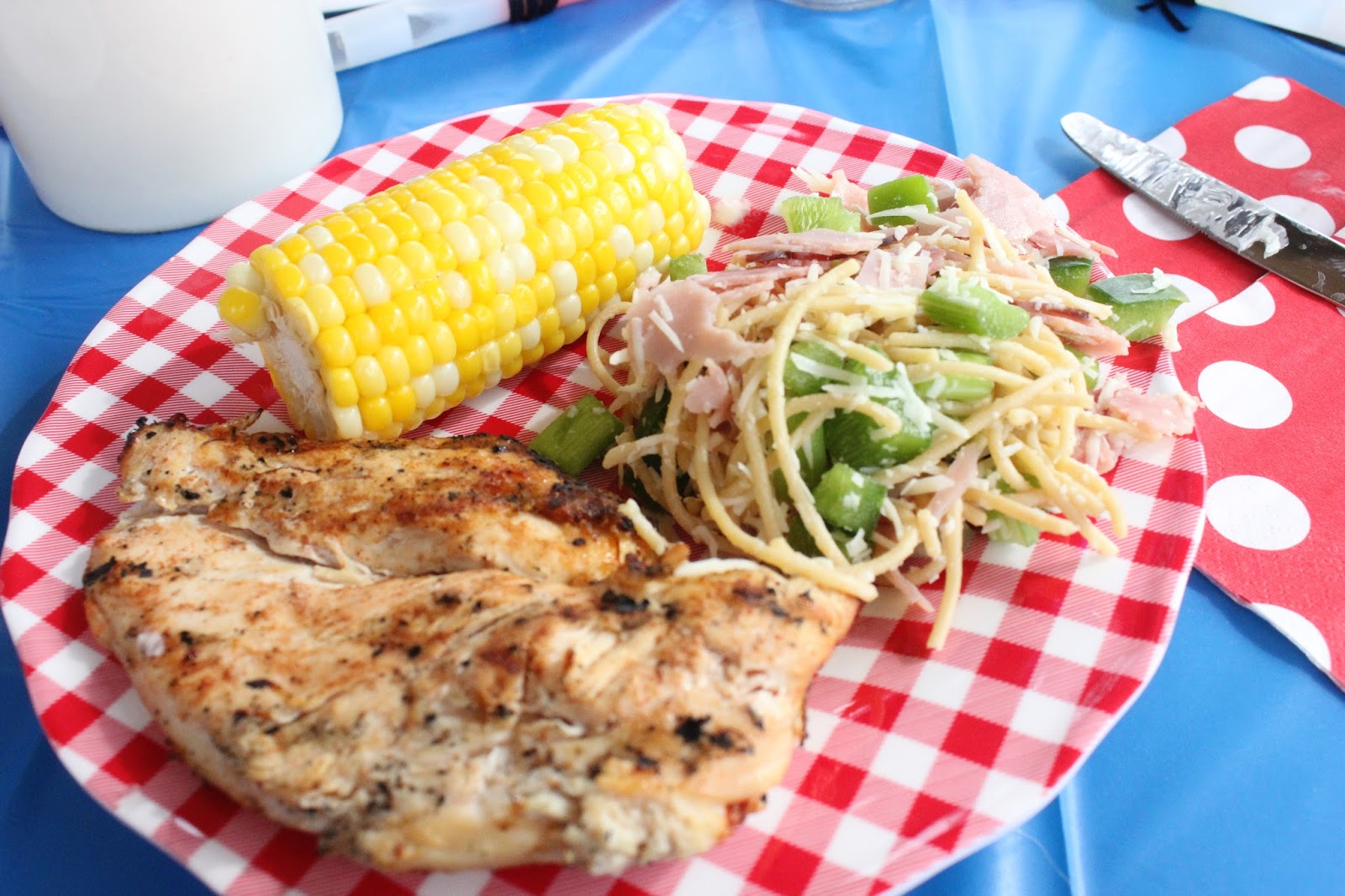
The menu: deviled eggs, pasta salad, corn on the cob, watermelon, and grilled chicken. All home cooked. All delicious as hell.


One of my favorite pictures of my mom.


 Our first legitimate fireworks display, of which I could not get one damn decent shot.

Ice cream sandwiches for dessert. Yummy!

And then for the rest of the weekend, we just hung out. While Mom prepared to go back to work, Dad and I went to see Monsters University and then, as we always do, we played Monopoly.


And then it was two weeks of ups and downs. Learning to parallel park, which I'm very sure will come in extremely handy all four times in my life I'll probably use it. Actually I learned a lot the last few weeks: how to parallel park, how to change a propane tank, how to clean a grill, how to fill a lawnmower tank, how to make Japanese chicken noodle soup, how to capture raindrops on camera, how to make red velvet cake...

Oh right. That cake. The reason I had to make it was so that I could go up to Interlochen and surprise my fiancee.


Dad took this picture, taking great care to include the trees in the background.

I was initially supposed to work at Interlochen with her this summer. Plans changed, I had to stay home--but she went up to camp anyway. Since I only live a few hours away from the Interlochen campus, I actually was able to visit her once during the summer. But, with my mom (a.k.a. the Keeper of the Car Keys) I developed another plan this past weekend. Her birthday was coming up, and I wanted to do something no one else had done for her before: surprise her on the big day.

Well. The day before the big day, because that was the only time I could go up. But close enough.

We bought the presents on Thursday--a red (her favorite color) Pandora bracelet with two charms: faith/hope/love (we're both Christians) and an Eiffel Tower (to say she's a Francophile would be an Epic Understatement). I laid the foundation: told her to be in her cabin at 2:30 on Saturday, because my "associate" was going to take her something from me, but that was the only time it could be done. And then on Friday, I baked the cake...and the cupcakes...and made cream cheese frosting.

Oh, boy.

That cake.

Okay, here's the thing. I love baking. Am I good at it? Well...not necessarily. Nothing I've ever made looks like a picture from a magazine. But I love doing it. And hey, it never looks like something out of a magazine, but I've never gotten any complaints about how anything I make tastes. I'm kind of the head cake planner in my family. Remember those celebrations I talked about earlier? Guess who's usually the brains behind the desserts? That's me. What I lack  in raw artistic talent I make up in imagination and (a hell of a lot of) determination.

But I'd never made red velvet cake before last Friday. And I don't think I ever want to again.

I neglected to take photos of the cake-baking process out of sheer human decency. Trust me, no one wants to know what a red velvet cake looks like in raw form. Not even bakers who specialize in red velvet cake want to know what it looks like; if they are smart, they blindfold themselves and bake the cake by either sonar or muscle memory. I sure as all living hell did not want to know what it looked like. And I assure you nothing but true love for this woman could have made me keep going once I saw what the batter looked like.

I got two words for you, blog-lovers: human and blood. Human blood. That's what that stuff looked like. My mom went as far as to compare it to a placenta. I wouldn't know. All I know is that red velvet cake batter looks like something that should be in a high school haunted house and nowhere else (and especially not in my kitchen). I've always been that kid who wants to lick the mixing bowl after the cake goes in the oven. As you may imagine, for the first time in my life, I had no such desire whilst making the red velvet cake. And after the whole experience, I don't think I'll ever have the desire to consume anything under the heading of "red velvet" again.

But I did make it, and I got it into the oven. I think I overcooked it a little--red velvet cake is one of those annoying cakes that gives very little visual cue as to whether or not it's actually done--but I didn't burn it, and later on Ella had no complaints about the taste, so I don't think I did too badly. Then I made the cream cheese frosting and frosted the cupcakes (and despite my best efforts, ate about six tons of it in the process), cut the lone round 8-inch into a heart, frosted that, wrote "Happy B-Day Ella" in melted chocolate (which was a hell of a lot harder than I thought it would be), and dusted the mini cupcakes in red sugar. 

Then, I had to figure out how to transport the cupcakes. Eventually I settled on extra-deep square Tupperware containers. I loaded up the Tupperware, used a pancake turner to transfer the sticky heart cake into its container, and used foil to cover the one container that didn't have a lid. There. Cupcakes done. Now all I had to do was pick up balloons, a teddy bear, and potentially flowers the next day on the way to Interlochen. The plan was to go to our usual Saturday morning nutrition class (no one will believe me when I say this is fun...but it is!), and then drive to Interlochen, set up a picnic table somewhere on campus with paper plates, plastic forks, and a dazzling cupcake display, knock on Ella's door, and after our joyful tears-and-hugs reunion, lead her to our newly set-up party. Simple, or so I thought.

Oh, if only I'd known.

On Saturday I woke up to a disturbingly gray sky. No problem, right? We'd be totally fine; the weather can change in a heartbeat in Michigan, and besides, maybe it'd be sunnier up north. (Yeah, right.) After the class, we had to come back--I forgot a letter that had come to the house for Ella, and Dad had forgotten his glasses. So we had a little setback. No big deal, right? We could still get there before 2:00 and have plenty of time to get the teddy bear and balloons. Right?

The weather turned to crap long before we got there. It was raining a half hour into the drive. I was worried, but not too much...it could still clear up, I was sure of that. In the meantime, I pulled off an outfit change in the car, no small feat as my dad was driving and my parents were teasing me every step of the way--according to them I flashed half the drivers on the interstate.

By the time we got there--late--I was freaking out.  My debit card wasn't working, I had less than fifteen minutes to get a teddy bear and bunch of balloons, and there was no party store at Interlochen like I'd thought...only a Dollar General, and not a very good one at that. I ran around the store, looking for a stuffed animal--it went from a teddy bear to ANY stuffed animal--while Dad supervised the inflation of ten Happy Birthday balloons, one of which popped during the inflation process.

I was getting desperate. At the last minute, just as I was about to throw myself onto the floor and cry (a very mature reaction to the stress, I know), I saw a huge, fluffy bear sitting on a high shelf on the other side of the store. I practically sprinted to the shelf, got the bear down, and hugged that thing like it was my long-lost best friend. A bouquet of silk hydrangeas--because real ones would wilt, and I didn't want that--and the mostly-surviving balloons, and we were done. We got back in the car and, just barely, managed to get to Interlochen by 2:40.

It was actually raining by then. I half-ran to her cabin door, ducking down by the window so she wouldn't see me coming, got into position, and knocked.

Aaaaand...no one answered.

I froze on the step. Oh no, oh no, oh no. Was I too late? Had she up and left, sick of waiting for the mysterious surprise to arrive?  Had she outsmarted me, decided to hide in the trees and sneak up on me while I stood there unsuspecting, holding an armful of cliche gifts? Had I blown it?

I took a deep breath. Calmed the hell down. Knocked again. I was going to call out, see if anyone was there, but I was afraid it'd ruin the surprise if she heard my voice. I knocked a third time and waited. Most of the window on the door was covered by a poster board sign, but I could see someone moving. Was it her? I took a step back, in the interest of not getting knocked over by the door.

It was her. Sleepy-eyed, without glasses, looking utterly confused. For a minute she just stared at me, blank and bleary-eyed. And I just stood there in the increasingly heavy rain, still laden down with presents, until I finally said in a tiny voice, "Surprise?" I didn't mean for it to come out like a question, but it did.

Then she recognized me, and made me come in. She was the only one in the cabin, and she had fallen asleep waiting for me. I barely got over the threshold before she pulled me into a hug. I had to convince her to let me go so I could put down the stuff I was holding and hug her back. "I missed you. I missed you so much," we both said over and over.

There was no one else in the cabin. We sat side-by-side on her bed, and I told her all the trials we'd gone through to get here. "Your parents are here?" she gasped, looking at me like I'd just told her the moon was made of green cheese. "They drove you all the way up here just for this?" I told her they had, and that prior to the rain, we were going to have a little party for her. She looked like she was about to cry when she heard the past tense. "No one's ever thrown me a birthday party," she told me.

I stood up and grabbed her hand. "C'mon, let's go fix that."

We huddled under her umbrella and ran for my parents' car. With nowhere else to go, we drove to the laundry cabin, which had an awning/porch that would shield us from the rain long enough for her to blow out the birthday candles. We all got out of the car. I made Ella close her eyes while we lit the candles. Dad broke out his phone and taped us singing Happy Birthday. I wish I'd had the foresight to snap a picture of Ella blowing out the candles--but I got plenty of pictures of her opening her presents, so that made up for it. 


Then we went to Dove Song, this pretty little hippie-type shop in Interlochen village, and I found a ring that I resolved to get for Ella as soon as my damn debit card started working again. We ended up walking around outside for a bit after the rain stopped, while we waited for my parents to get back from the grocery store. Then it was back to Interlochen campus, where we delivered all eight thousand mini cupcakes to Intermediate Girls HQ for Ella's co-counselors. And then Ella and I had to go back to her cabin and say our good-byes.

I'll be honest here: I didn't want to stay in that cabin any longer than I had to. The rain was starting again, and you'd think it'd be all peaceful and quiet, but it kind of...wasn't. It was eerie. And kind of damp. And cold. And did I mention I was wearing a skirt? But I stayed and we hugged and pouted about leaving each other--again--and then she reminded me that we'd see each other again soon enough; camp is over next Monday. So I left, but kept calling "I love you" to her through the closed cabin door, and she kept saying it back until we were both out of earshot of each other.

But on the way home she called me, practically crying (or at least, it sounded like it) that she'd forgotten to give me this letter she'd written for me. I told her, it's okay, you can give it to me next Monday, or if you really want me to see it right away you can send it through the mail, I'm only a few hours away. She calmed down, and all was okay again...but I still made sure to let her know when we were home safe that night. Just in case she wasn't sure we'd make it.

One week until I see her again. Two weeks until she goes back to Maryland, and I won't see her until Christmas. Three weeks until what might be the biggest change of my life so far. I don't know. I'll keep you posted.

Friday, July 5, 2013

A Scary Thought: Reflections on 'Monsters University'

[Potential spoiler warning--I'm doing my best to keep this spoiler-free, but discussion of thematic elements may give away ending; if you haven't seen the film, proceed with caution.]

As far as measuring up to the original goes, Monsters University isn't too bad. The fan service is liberally applied, the team of John Goodman and Billy Crystal is hilarious as ever, the ending is happy, the jokes are plentiful, and the Disney element outweighs the Pixar. It's generally likeable. I wouldn't put it on my top ten worst list. On the other hand, I sure as hell wouldn't put it on my top ten best list. It doesn't even break my top 5 favorite Pixar films. (If you guessed the original Monsters, Inc would be in that list, you would be right.) That right there should tell you something.

Is Pixar losing their touch? I don't know. I loved Brave, and Toy Story 3 was as loveable a tearjerker as its predecessors. But Monsters University missed the mark for me. It's probably because I'm a jaded film student, I'll admit. I have no doubt that die-hard Pixar followers and elementary schoolers, a.k.a. the target audience for the film, will love it. But for me, it just didn't cut it...and not for the reasons you might think; like I said, the fan service was incredible. And yet...there was something that just felt off.

For me, the faults in the film come down to three major points:

1) The "you can be your own hero" message is lost in the mess of Hollywood cliches. Wreck-It Ralph had this problem too, and from what I saw of the previews, so will the next batch of tried-and-true Disney confections. In every film, there is a common thread: an underdog fights his/her way to the top and beats all the odds to become--ta-da!--a hero! Monsters University is no exception. Underdog Mike Wazowski is shown as a hardworking, determined, everyman kind of guy who just wants to do well in school; thus, naturally, he becomes a "hero" at his school (only after defeating the token evil popular guys, of course). I'm so sick of seeing this trope in movies I could puke. If it's "okay" to not be a hero, Disney and Pixar, then why is it that in every movie you release, there is always at least one hero, usually a token underdog like Mike? If it's okay to just be normal, then why does the good guy always win in your films, and why does the bad guy always lose? Why are there no grey areas between winning and losing, heroes and villains? Which brings me to...

2) The characters are so one-dimensional it's actually sickening. Just like in every other fucking high school/college movie ever made in the history of cinema, the popular guys are terrible douchebags who have status but no tact, and the nerds/underdogs are lovable, compassionate, gentle, and of course brilliantly smart. There's no middle ground. The message is clear: if you're popular, you are a jerk and your appeal is fleeting; if you are not popular, you're wonderful and it's just that no one else has seen it, but don't worry, they will eventually. And of course Randall, Mike's roommate, starts off his uncool best friend, but as soon as he gets a taste of popularity, what does he do? Of course he denounces Mike and runs off to join the ranks of the populars--why wouldn't he? How dare you even suggest he could have stayed friends with Mike and joined the fraternity on the side? Oh no, he's popular now, therefore he  must turn into an insufferable jerk! And of course Mike's new friends, the geeks, are all so pathetic and helpless they need their fearless leader to turn them into glorious champions. There's never any middle ground. According to Disney, you are either a forceful popular leader and a total asshole, or you're a doormat geek with no life who lives with their parents. Which brings me to...

3) The parent-child relationship is just plain nonexistent. Either the parents are helicopters, like Squishy's mom, or totally absent, like Mike's parents. There's no middle ground there, either. Squishy is a total joke for living with his mom, while poor Mike and Sulley get no support from their parents whatsoever. There's nothing that even remotely resembles a healthy parent-child relationship. Remember the perfect balance struck by the parents in Easy A? Remember how Olive's parents loved her to bits, but also knew when to stay out of her business? Remember that natural, realistic, balanced portrayal of a parent-child relationship? Well, you won't find it here. Remember, through a teenager's eyes, it's not possible for a parent to be anything other than an embarrassment or a parole officer.

You know what I'd like to see, just once? I'd like to see a movie where the lines are blurred. Where the popular kids are a mixed bag, just like any other group--where there are some jerkwad popular rich snobs, but there are also some likable, Captain America-style popular kids who get involved in anything and everything and have tons of friends and that's why they're popular. And the geeks aren't all nice and quirky and brilliant and naturally lovable, they're human just like the rest of the kids. I'd like to see friendship between the popular and unpopular, because believe it or not, that happens in real life just like the clique barrier.

I'd like to see a movie that, instead of endlessly extolling the merits of friendship, acknowledges that some people are better off on their own, and that is perfectly okay. Not all loners have that posse of lovable nerds to back them up. Some of them are just that--loners. They prefer to be alone. They like being alone. And that is totally okay. You don't have to have a circle of friends. You can just have one best friend, or hell, just be friends with your parents. That's okay too.

I'd like to see more movies like Juno and Easy A, where the parents are a part of the kid's life, a natural part of the kid's life, without taking it over or fading out of it completely. I'd like to see more movies where the parents are neither buffoons nor jailers, they're simply parents, just people who want to do the best by the people they love most: their kids. I'd like to see more movies where the kids have a relationship with their parents like I have with mine.

I'd like to see a movie that acknowledges that, no, not every underdog will beat the odds, and not every misfit will end up a hero. Life doesn't always hand you that silver lining. Sometimes, it has to be enough just knowing that you did what was right by yourself. Sometimes, you have to be alone. Sometimes, you just have to face that you aren't that good, and you have to find another way to get what you want. While Monsters University touched on this briefly, the film would have been so much better if it actually went in-depth--meaning, yes, Mike realizes he just isn't that scary. And I love that. But instead of showing an alternate path, he just finds another way to indirectly be a scarer. And all the geeks, all the other underdogs, what happens to them? They become scarers too.

I want to see a movie about an ordinary person doing ordinary things and being happy with who they are even though they aren't secretly a heroic badass who can save the day when everyone else is saying "You're not enough." I want someone who will look back at those naysayers and reply, "No, I am not enough, I will never be enough to save the day, but you know what? I'm enough by myself, and I'm proud of who I am even though I'm not 'enough' for you." I want to see a movie like that.

Hmm...I think I'll write one.

The Ultimate Summer Playlist

I am a true music nerd. I love a huge variety of bands, and I know waaay too much about my favorites. I have playlists for everything--homework, housekeeping, cooking, boredom, highway driving and, of course, seasonal.  And to me, nothing says "Summer!!!!!" like roaring down the street with the windows down and your radio blaring. Maybe your choice of radio-blaster is Bruce Springsteen; maybe it's Justin Bieber, but whoever it is, this is the time to blast them loud and proud! You don't have long, only another two or three months until it starts getting colder and you're forced to contain the sound by closing your windows. So don't be shy, blast out those speakers! Want/need any suggestions? Here are some of my staples:

Seaside Bar Song by Bruce Springsteen
Bruce Springsteen is pretty much the ultimate summer-friendly artist, but this song really takes the cake. Hard to resist rolling down the windows and roaring along the highway on a summer night when you're listening to a song about, um, rolling down the windows and roaring along the highway on a summer night.

Souls on Ten by The Almost
If this song doesn't immediately pick up your mood, I don't know what will.

Beat It by Michael Jackson
This song falls squarely into the category of "Songs Avery Knows She Sounds Terrible Singing But Will Sing Along Every Time Regardless." Just watch out, it's highly danceable and you don't want to start tapping your foot while driving.

Basket Case by Avril Lavigne
Back in the days before she went hyperactive pop princess on us, Avril Lavigne had good taste in cover songs and actually knew how to belt in concert. This is one of the rare occasions that I actually prefer the cover over the original song.

Forces of the Unseen by Cloud Cult
Cloud Cult is one of those bands that I just can't even believe really exists. Every time I hear one of their songs, I'm just blown away at how incredibly well composed, arranged, and performed their music is...and this song in particular just blows my mind. "Please say it can't be done, 'cause that's just fuel for me to just prove this, yeah you'll see?" Genius.

San Francisco by Vanessa Carlton
If her voice doesn't send chills down your spine, and her lyrics don't put tears in your eyes, then I don't think we can be friends.

Summer Medley 2011 by Sam Tsui/Kurt Schneider
Sam Tsui is such a good singer that he can give even the most vapid pop songs emotional depth. As for Kurt Schneider, the genius behind the arrangement, he managed to mesh "Party Rock Anthem" with "Edge of Glory" and "Last Friday Night" so well that they sounded like one complete song. Impressed? I know I am.

One World by Utopia
This song sounds like it could be the theme of a TV show or the opening credits of a movie. On a side note, I will never cease to wonder how such a sarcastic smart-ass as Todd Rundgren can make these lovely, upbeat, feel-good songs.

Change Your Mind by The All-American Rejects
Another movie montage-worthy song. I've actually found this one to be pretty multi-purpose--it's a good workout song, a good road trip song, housework song, and just general pick-me-up song.

No Sleep 2Nite by The Faders
This all-girl band reminds me of The Runaways: aggressive, exciting, and damn talented. They are also highly underrated. If you like Katy Perry, Lady Gaga, even Ke$ha, you need to check this band out. It's non-negotiable.

Cherry Bomb by Joan Jett and the Blackhearts
And speaking of the Runaways...only the woman behind their existence could take one of their songs, pieced together during their lead-singer auditions, cover it with her hard rock band, and sound even better than the original. Joan Jett, leather-clad bad girl, will never ever cease to be one of my key inspirations.

The Middle by Jimmy Eat World
Just try to keep from singing along and fist-pumping to this song. (Hint: It's not possible.)

Hey Now by Augustana
And last but not least, we have the ultimate summer slow-dance song. I can't help but think of kisses and hand-holding under a starlit sky on  a warm summer night when I hear it. The soaring strings, the belting vocals, the poetic lyrics, the lulling guitars...it's just incredible.

Wednesday, June 19, 2013

The Perfect Storm

Well hello there. I apologize for the long absence. Things were happening. Changes were being made. I can't explain any further than that right now. Just know that my hipsteresque ways were not at all harmed by the metamorphosis. To prove that this is the case, I will now present you with my latest round of artsy photos, taken during a recent storm that evoked both a tornado alarm and an emotion that I can only classify as "pure exhilarating terror."


First the sky just looked like an ordinary storm, but then...


...it got intense. REALLY fast.


Yes, that is what it looks like when a tornado starts to form.


The sky got dark fast. My parents came out and took photos with me. My mother wanted to get undercover before the storm hit. My dad wanted to be a storm-watcher. So did I.


The noise was absolutely deafening. The rain sounded like a drumline on crack. Imagine God taking the biggest pots and pans and crashing them together--that was the sound of the thunder. Imagine the world's biggest pile of tin cans collapsing into a raging ocean. It was that loud.

But the sky after the storm was just unbelievably gorgeous. Looking at the sunset, you'd never know that it was storming like a monster earlier.


And this is why I love living in Michigan.

Thursday, May 16, 2013

Beauty and the Beast vs. Labyrinth vs. Twilight - A Feminist Analysis

[Note: This is the term paper for my fairy tales Sophomore Interdisciplinary Studies (SIS) class. The purpose of the SIS, as far as I can tell, is to throw in a hard-as-fuck class for the sophomores so that they get the point that college is not supposed to be easy. (Like we didn't know that already.) The other purpose is to show us how to use multi-disciplinary subjects in a harmonious way. For the fairy tales class, our subjects were, to name a few, gender studies, literature and orature studies, storytelling, multicultural...the possibilities were endless. This was my final paper, which earned a grade of 96, the second-highest grade I've ever gotten on a term paper.]

[Note 2: Yes, for anyone wondering, I will eventually post something besides term papers.]


Progressing and Regressing: Beauty and the Beast in the 21st Century Media
After growing up watching the 1990s Walt Disney Pictures version of Beauty and the Beast, with its spunky heroine and multi-faceted man-turned-monster, the version by Jeanne-Marie Le Prince de Beaumont which appears in The Classic Fairy Tales may seem like something of a letdown.  Indeed, the heroine of Beaumont’s eighteenth-century tale is as gentle and passive as her 1990s counterpart is fiery and spirited, a true testament of the different eras--after all, in the 1700s, it was not exactly considered proper for young women to engage in adventures and read books,which the Disney film seems to enjoy mocking with Gaston’s insistence that a woman shouldn’t be “getting ideas” from books.  However, that is the difference between the 1990s and the 1750s; it is quite a different story when the analysis of a film made in 2008 reveals gender-related stereotypes and conventions that would not have seemed out-of-place in Beaumont’s written version of the original oral tale.
The films analyzed for this paper were, in order of release, Jim Henson’s Labyrinth (1986), Disney’s Beauty and the Beast (1991), and the film adaptation of Stephenie Meyer’s Twilight (2008). While Beauty and the Beast is obviously the most direct adaptation of the original tale, the others were selected for their similarities in plot and theme, mainly the concept of a young woman falling in love with, or being romantically pursued by, a non-human or fantastical creature.  Each of the three films was made within the past 30 years, however there is quite a time jump between Beauty and the Beast and Twilight (17 years to be precise).  Each film was made with a youthful audience (children or teens) in mind, with Twilight and Labyrinth presented more as coming-of-age films while Beauty and the Beast was presented as predominantly a child’s film. Most importantly, the films as a group revealed a surprising trend: as the years progressed, the heroines regressed in terms of strength of character, feminist tendencies, and general independence.
To understand the context of the films, it is important to first understand the original tale of “Beauty and the Beast,” as captured by Madame Beaumont.  What is most telling about Beaumont’s story is the characterization of both Beauty and her Beast: Beauty is gentle and extremely passive, preferring to simply allow things to play out as they will rather than take proactive action, while the Beast is a modest, gentle being who insists on courting Belle rather than forcing her to marry him. Within a few months of her arrival, it is apparent that he truly loves her; when she says her separation from her family is too painful to bear, he replies “I would rather die myself than cause you pain.” (Beaumont, Beauty and the Beast, 39) Beauty, however, only realizes that she loves her Beast at the moment of his death. Before this, it is a mixture of guilt (for staying home longer than she promised the Beast she would) and practical thinking (“I would be more happy with him than my sisters are with their husbands...I may not be in love with him, but I feel respect, friendship, and gratitude toward him”). (Beaumont, Beauty and the Beast, 40)
The story is fairly obvious in its moral instruction,  promoting the preference of virtue over looks and status. No time is wasted in telling us just how charming and virtuous Beauty is in comparison to her prideful, arrogant older sisters: “[Beauty] was not only more beautiful than her sister, she was also better behaved...Every day they went to balls, to the theater, to the park, and they made fun of their younger sister, who spent most of her time reading good books.” (Beaumont, Beauty and the Beast, 32) Beauty is also more patient and kind, thanking her suitors but rejecting their proposals because she feels too young for marriage, while her older sisters hold out for men of higher rank. At the end Beauty and her husband are rewarded for their virtue, him by returning to human form and her by becoming a queen, but her two sisters are punished for their “malice and envy” by getting turned into statues. (Beaumont, Beauty and the Beast, 42) The moral is clear: if you are good and virtuous and value a good heart over looks and intelligence, you will be rewarded; if not, you will be punished.
However, the theme of virtue is merely the tip of the iceberg, according to Maria Tatar and Bruno Bettelheim, both of whom believe the tale to be a reassuring allegory to a young newlywed’s wedding night. Bettelheim believes the tale soothes fears concerning the loss of virginity: “While sex may at first seem beastlike, in reality love between woman and man is the most satisfying of all emotions, and the only one that leads to permanent happiness.” (Bettelheim, 306) Tatar describes “Beauty and the Beast” and its multicultural variants as an allegory of arranged marriages, saying that “these tales mirror social practices of an earlier age.” (Tatar, 27) She goes on to say that “Many an arranged marriage must have seemed like marriage to a beast, and the telling of stories like ‘Beauty and the Beast’ may have furnished woman with...therapeutic advice, comfort, and consolation,” (Tatar, 27) reinforcing Bettelheim’s theory that “Beauty and the Beast” is really intended to calm engaged young woman concerned about losing their virginity.
With all of this in mind, let’s take a look at Disney’s Beauty and the Beast, made in 1991 and the most direct adaptation of the tale researched for this paper.  In his essay “Mass Marketing ‘Beauty,’” Marc DiPaolo calls Belle (the Disney incarnation of Beauty) a feminist heroine and praises her for being “far more intelligent than anyone else in town.” (DiPaolo, Mass Marketing Beauty, 170) In the film, Belle is not your average princess. Like Beaumont’s incarnation of Beauty, Belle spends much of her time reading, falls in love with the beast despite his looks, and loves her father to the point of sacrificing herself for him--but there, the similarities virtually end. This Belle has a feisty side and a wide feminist streak. In her film, she rejects her arrogant suitor not because she loves her father, but because she does not love the man who proposed, she craves adventures far beyond the safe boundaries of her strictly traditional French town, and when she and the Beast disagree, she isn’t afraid to (loudly) let him know that she doesn’t approve of what he has to say. Not that she has little reason to push back: the Beast of the Disney film, instead of representing the gentle, if stupid and unattractive, beast of Beaumont’s tale, is truly a loud-mouthed, selfish, bad-tempered monster who only realizes he loves Belle when she is nearly killed by a pack of wolves.
DiPaolo compares Belle favorably to the young women of modern media, noting that while she may not be a feminist icon compared to, say, the heroine of a Margaret Atwood novel, she “stands head and shoulders above the nightmarish role models available for young women today,” (DiPaolo, Mass Marketing Beauty, 172) and Allison Craven says she is “barely recognizable as the traditional fairy-tale Beauty.” (Craven, 130) However, as DiPaolo notes, her story does indeed end with a traditional marriage and the implication of her “happily-ever-after” with her newly-transformed lover, which reinforces that women do need men in order to be happy. So while Belle does prove herself a strong woman, she also falls into stereotypical gender roles in her need for marriage. In terms of feminism, it’s not exactly a full step back, but it can be read as “taking away from” the character’s independence.
Contrast that with a film made five years prior, Jim Hensen’s muppet-filled semi-musical Labyrinth (1986). The plot is simple, but the “Beauty and the Beast” elements are clear: When young Sarah, unaware that the Goblin King has fallen in love with her, wishes that the goblins would steal her baby brother, her wish is immediately granted, and she must go get him back by solving the king’s labyrinth in 13 hours or less. Sarah is at her wit’s end when the Goblin King (played by, of all people, David Bowie) throws challenge after challenge at her, but she is even more stunned when he professes love for her at the end of his maze. The film makes several references to the tale type of “Beauty and the Beast” throughout the story: non-human creature (in this case, a goblin) pursuing a human girl, a young girl willingly going into a dangerous situation (the labyrinth) to save a family member (in this case, her brother) from an unknown creature (the Goblin King), who may or may not turn out to be benevolent. But there, once again, the similarities end. Unlike her fairy-tale counterpart, Sarah is not passive in the least. Through the whole film, she is a proactive force and eventually learns not only to love her younger brother, but to trust her own strength.
As Elycia Arendt puts it in her essay on Labyrinth, “If ever there was a fairy tale heroine battling against a patriarchy, this is it.” (Arendt, 42) Right from the beginning of the film, Sarah is shown to want a career--she wants to be an actress. She is expected by her father and stepmother to “take the role of a domestic woman” (Arendt, 41) and is pressured by her stepmother to start dating. (Labyrinth) Like Beauty, she rejects the idea of courtship because she isn’t ready yet, and she rejects the idea of herself as a child’s caretaker by wishing her brother away. Later on, inside the labyrinth, she confronts obstacles at every turn, the majority of them male, and conquers or evades them all, and even befriends some of them. Finally, she rejects the idea of herself as Jareth’s wife when he asks her to be his queen. “Fear me, love me, do as I say and I will be your slave,” he promises--but Sarah’s having none of it, and replies quietly but confidently, “You have no power over me.” (Labyrinth) Sarah is the only one of the four heroines examined in this paper who actually, completely rejects the idea of marriage to her non-human suitor. The others, even the feisty Belle of the Disney film, eventually submit to their non-human lovers. Keep in mind, this film was made in the teen-film era of the 1980s, where women were mostly love interests or sexual objects. Sarah is neither: she is a feminist incarnate, who rejects stereotypical roles of mother/caretaker and wife/lover and demands something bigger for herself.
But take a leap into the year 2008, when the film Twilight was released, and look at the female lead of that film, Bella Swan. Again, she is a human who captures the romantic attentions of a non-human creature--in this case, a vampire, Edward Cullen, who frequently refers to himself as a monster. (Twilight) Interestingly, Bella portrays more characteristics of the original Beauty than either of the heroines in the other two films: she is introverted, naive, passive, selfless, and above all, ultra-feminine. In the novels on which the film was based, she faints at the sight of blood; in the film, she watches helplessly while Edward fearlessly saves her from an out-of-control truck and from a group of cartoon-villain sexual predators. Moreover, she is conventionally beautiful and, though it is never outright stated in the film, it is implied that she is inexperienced with men. While the other film heroines, Belle and Sarah, are also beautiful and virginal, they don’t possess those qualities in addition to all of the other virtues that both Beauty and Bella display in their respective stories.
Fleur Diamond calls Bella’s behavior “what adolescent girls are pressured to perform on a social level: to assume a sexually conventional exterior while a fugitive text of female sexual agency is suggested between the lines.” (Diamond, 47) What this means is that she is the paragon of femininity in our culture: beautiful and sexually desirable, but also sexually inexperienced. Young women are expected to “camouflage their desire for sexual activity or risk being ostracized” (Diamond, 44), a throwback to the era of the original “Beauty and the Beast” tale, when young women were not just encouraged or suggested, but required to be virginal on their wedding nights. In addition, Bella is portrayed as a caretaker (the very thing that Labyrinth’s Sarah fought so hard against becoming) by looking after her divorced bachelor father and scatterbrained newlywed mother. She also is willing to do whatever it takes to serve others: she moves away so her mother can be with her new husband, endures awkwardness for the sake of entertaining her father’s best friend’s son Jacob, and is even willing to give up her life for that of her mother and Edward. (Twilight) Her interactions with Edward, while romantically charged, are mostly chaste; they share a grand total of three kisses on-screen and when he spends the night at her house, all he does is watch her sleep. But the biggest indication of Bella’s femininity is her helplessness: like Beauty, she is utterly passive, allowing Edward to take a fully dominant role in their relationship. She can even be seen as more passive than Beauty, in that Beauty initially resists the Beast’s advances, while Bella immediately succumbs to Edward’s.
It is most interesting that Bella, the anti-feminist, is the heroine of the most recent film, while Sarah, the strongest feminist, is the heroine of the oldest. When comparing all three--Bella, Belle, and Sarah--to Madame Beaumont’s Beauty, it is clear who embodies the majority of the original values associated with the fairy tale. Sarah of the 1980s rejects her gender’s stereotypes and places her friends and her dreams of a career above all else. Belle only marries her suitor once she has firmly established her own identity. But Bella--Bella, the lead character in a film made during an era where women are fighting and screaming for independence--the lead character of a film that grossed almost $200 million at the domestic box office and is the subject of discussion of millions of women worldwide--falls in love, submits herself, and that’s the end of it. One more thing to think about: In 1756, the year “Beauty and the Beast” was published, women were still thought of as property. In 2008, the year Twilight was released, Hillary Clinton became the first woman to run for President of the United States...and yet the heroines of both stories show matching values, above all the value of a woman learning her place under a man.

Bibliography

Arendt, Elycia. Braveheart and Broomsticks: Essays on Movies, Myths and Magic. Infinity Pub, 2002.

Beaumont, Jean-Marie Leprince. "Beauty and the Beast." In The Classic Fairy Tales. Ed. Maria Tatar. New York: Norton, 1999: 31-42.

Bettelhelm, Bruno. The Uses of Enchantment: The Meaning and Importance of Fairy Tales. London: Penguin Books, 1991. pg-pg. Print.

Craven, Allison. "Beauty and the Belles Discourses of Feminism and Femininity in Disneyland." European Journal of Women's Studies 9.2 (2002): 123-142.

Diamond, Fleur. "Beauty And The Beautiful Beast." Australian Feminist Studies 26.67 (2011): 41. MasterFILE Premier. Web. 25 Apr. 2013.

DiPaolo, Marc. "Mass–Marketing Beauty ‘: How a Feminist Heroine Became an Insipid Disney Princess ‘." Beyond Adaptation: Essays on Radical Transformations of Original Works (2010): 168-180.

Twilight. Dir. Cathrine Hardwicke. Summit Entertainment, 2008. Film.

Labyrinth. Dir. Jim Henson. TriStar pictures, 1986. Film.

Tatar, Maria. The Classic Fairy Tales. 1st ed. New York: W. W. Norton & Company, 1999. Print.

Beauty and the Beast. Dirs. Garry Trousdale and Kirk Wise. Walt Disney Pictures, 1991. Film.